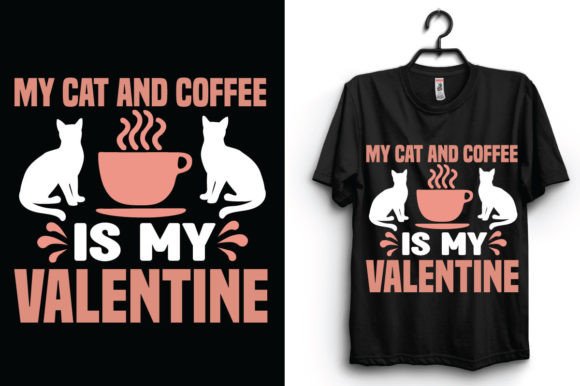
My Cat and Coffee is My Valentine
Every so often a design crosses my desk that instantly sets a mood before I even load it into my software. My Cat and Coffee is My Valentine is one of those pieces. It feels like a quiet February morning, a warm mug between your palms, a purring cat curled nearby. As someone who has spent years testing designs on actual garments, bags, and home textiles, I look at this and immediately start picturing finished products rather than just a screen preview. That instinct alone tells me a lot about its real-world potential.
The composition blends two universally adored themes, cats and coffee, wrapped in a Valentine's Day sentiment. It is playful without being loud, sentimental without tipping into saccharine territory. For embroidery designers and small shop owners, that tonal balance is gold. You want a design that triggers an emotional response, makes someone pause and smile, and also feels wearable or giftable in everyday life. This one checks those boxes.
First Impression and the Mood It Creates
Opening My Cat and Coffee is My Valentine for the first time, what hits me is the warmth of the concept. The combination of feline charm and coffee culture has been trending in handmade circles for a while, and this design slots into that niche comfortably. It is the kind of artwork that a customer would spot at a craft fair, pick up a finished tote bag, and immediately say, "Oh, this is so me." That recognition factor is everything for small business merchandise.
The lettering, the shape language, and the thematic pairing all suggest a design made for cozy, heartfelt products. I can already envision this stitched out in a soft cream thread on a heathered pink sweatshirt, or reversed in a deep espresso brown on a natural linen pillow cover. It carries an aesthetic that leans toward modern farmhouse, a little bit whimsical, and entirely approachable. For Etsy sellers and boutique brand owners, that broad appeal matters when you are calculating how many listings a single design can power.
Where This Design Naturally Belongs
Not every design is versatile enough to cross categories, but My Cat and Coffee is My Valentine has that adaptability. I would confidently place it on a whole list of finished products without stretching its thematic fit. Tote bags come to mind first, especially the sturdy canvas ones that customers use for book hauls, farmers' market trips, or simply carrying their current knitting project. A stitched version of this on a natural tote with a gusseted bottom would look like a premium boutique item.
Sweatshirts and relaxed-fit tees are obvious candidates too. The laid-back vibe of the design pairs beautifully with soft, worn-in apparel. For holiday gift collections, this could anchor a Valentine's mini launch, perhaps alongside a matching mug or a set of embroidered tea towels. I can also see it working on kitchen textiles, think flour-sack towels hanging by a coffee station, or a custom apron for the cat lover who starts every morning with a pour-over ritual.
Beyond apparel and linens, this design has patch potential. Embroidered patches are having a sustained moment, and a small, detailed patch version of this could live on jean jackets, backpack flaps, or even as a framed hoop art piece for nursery or home office walls. The cat-and-coffee motif makes it a candidate for pet-themed craft markets, which I have seen draw surprisingly passionate crowds.
A Real Project Walkthrough: The Embroidered Tote Bag Test
Let me walk you through a practical scenario because theory only goes so far. I recently had a client ask for a custom gift, something personal for her sister who runs a small cat rescue and lives on cold brew. We settled on a heavyweight canvas tote, and I pulled up My Cat and Coffee is My Valentine as a strong contender. The design needed to read clearly at roughly five to six inches wide, work on a slightly textured natural fabric, and hold up to daily use.
Before committing to the final piece, I ran a test stitch on a scrap of the same canvas. I checked how the finer details, like any small interior shapes or lettering connectors, translated into thread. On a medium-weight cutaway stabilizer, the design held its structure nicely. I did notice that certain intricate areas would benefit from a slightly looser density if you are stitching on a fabric with visible weave, as overly compact stitches can sink into the texture and lose crispness. That is not a design flaw, it is simply a material consideration every embroiderer should factor in.
Thread color choices made a significant difference. I tested a warm taupe, a soft black, and a muted burgundy. The burgundy against natural canvas gave the finished tote a subtle Valentine's feel without screaming holiday merchandise, which means the bag could be carried well beyond February. The client loved that. For anyone planning to list My Cat and Coffee is My Valentine in their shop, I recommend showing mockups in at least two colorways to demonstrate range.
The recipient's reaction sealed my opinion of this design. She immediately recognized the sentiment, laughed at the perfect pairing of her two great loves, and hung the tote on her coat hook that same day. Products that spark that kind of immediate emotional connection are the ones that earn repeat customers and word-of-mouth referrals. As a reviewer who measures designs by real-world impact, that outcome counts heavily.
Fabric Choices and Where to Proceed Carefully
No design is universally foolproof across every material, and My Cat and Coffee is My Valentine requires some thoughtful selection. Thin or highly stretchy fabrics, like lightweight jersey or performance blends, can distort the design if not hooped with precision and paired with the right stabilizer. I would avoid placing this on anything too flimsy unless you are confident in your hooping technique and willing to use a topper to prevent stitches from sinking in.
Textured fabrics like waffle weave, thick terry cloth, or heavily napped fleece present their own challenges. The design's charm lies partly in its clean shapes and readable sentiment. On a surface that disrupts stitch definition, you risk losing the crispness that makes the artwork feel intentional. If a customer requests a plush blanket or a textured apron, I suggest testing a small section first and possibly scaling up slightly to keep details clear.
Dark fabrics also demand a bit of planning. If the design contains fine lines or delicate interior details, light thread on a dark background can expose every tiny gap or misalignment. I learned early in my career that what looks perfectly stitched on cream cotton can reveal imperfections on charcoal fleece. A quick contrast check, either in your digitizing software or by holding a printed reference against the fabric, saves disappointment. For a design like this one, a medium-contrast pairing often looks more intentional than stark black-on-white or white-on-black.
Small Hoop Sizes and Detail Management
One practical question I always ask when evaluating a new design is whether it shrinks gracefully. Some artwork loses legibility when scaled down for baby onesies, hat fronts, or narrow ribbon trims. With My Cat and Coffee is My Valentine, the core elements need enough room to breathe. I would not push it below about three and a half inches in its largest dimension without first examining how the interior spaces close up at that size.
If you cater to customers who want tiny embroidered accents, say on a collar point, a cuff, or a cosmetic pouch, consider whether the lettering details remain readable. Small text in embroidery can fill in quickly, especially if stitch angles or densities are not adjusted. A good habit is to stitch a mini version on scrap fabric and view it at arm's length, which mimics how a customer first sees a product in a shop photo or at a market table.
The Commercial Appeal for Small Shops and Etsy Sellers
Running an embroidery business, whether full-time or as a side hustle, means constantly evaluating designs through a commercial lens. You ask not just "Do I like this?" but "Will this sell, and will the finished product look professional enough to build trust?" My Cat and Coffee is My Valentine holds up well under that scrutiny. The theme is niche enough to attract a specific buyer yet broad enough to avoid feeling obscure.
Valentine's Day merchandise can be tricky. Many designs lean heavily into hearts and roses, which limits their selling window to a few weeks in late January and early February. This one, however, carries a cozier, everyday sentiment. A customer could buy a stitched pillow cover in March and still feel it fits their home. That extends the listing's active life on platforms like Etsy, where seasonal fatigue hits fast and shop owners need designs that transition smoothly between holidays and everyday gifting.
From a branding standpoint, this design also offers strong giftability. Personalization is a huge driver of handmade sales, and I could easily see adding a name, a date, or a short custom line beneath the main artwork. Offering personalization variants in your listing not only increases the perceived value but also encourages customers to purchase one-of-a-kind gifts for their own loved ones, expanding your shop's reach organically.
Stitch Quality, Thread Palette, and Visual Polish
Embroidery brings a tactile dimension that cutting files on vinyl or paper cannot replicate, and My Cat and Coffee is My Valentine gains a lot from that translation. The interplay of satin stitch borders and fill stitch areas creates a subtle texture that catches light differently across the design. I recommend selecting thread colors with a slight sheen, such as high-quality polyester or rayon, to enhance that dimensional quality. Soft matte cottons can work too, especially for a vintage look, but the design's playful personality leans more toward a clean, modern finish.
Thread count and stitch direction matter here. Pay attention to how fill stitches angle across larger areas. A consistent angle across connected shapes gives the finished embroidery a polished, harmonious appearance. If your digitizing software allows angle adjustments, aligning fills to follow the natural flow of the artwork's curves reduces distracting visual breaks and makes the design read as one cohesive piece.
Before listing a finished product, I always photograph it in natural daylight and under warm indoor lighting to see how thread shine and shadow behave. Buyers make purchase decisions based on listing photos, and a design that photographs flatly will struggle even if it looks beautiful in person. Fortunately, the varied shapes within this artwork, combined with the emotional appeal of the cat-and-coffee theme, give it strong photogenic potential for product listings and social media content.
Practical Designer Notes Before You Stitch
I will share the same checklist I run through before committing any design to a client project or shop inventory. First, always test on the exact fabric and stabilizer combination you plan to use for production. Scrap tests are cheap, remaking a failed customer order is not. Second, confirm your hoop size accommodates the design with enough clearance for proper hooping, especially if you use adhesive-backed stabilizers that require extra margin around the edges.
Third, print a reference sheet of the design at actual size in black and white. Hold it against your intended fabric to assess contrast and readability without color distracting your eye. This simple trick has saved me from countless subtle mismatches. Fourth, if the product description accompanying My Cat and Coffee is My Valentine includes any licensing details or usage terms, review those carefully. Understanding whether a design is cleared for commercial embroidery on items you sell is essential before you invest time in production and marketing.
Fifth, consider your customer base. If you primarily sell baby items, check whether the design scales down appropriately for bibs, onesies, and small blankets. If your niche is kitchen textiles, test how the design holds up to frequent washing and drying cycles. A design that looks beautiful fresh off the machine but deteriorates after ten wash cycles will generate returns and erode buyer trust.
Seasonal Timing and Inventory Planning
Timing matters for any design with a holiday association. If you plan to launch products featuring My Cat and Coffee is My Valentine for Valentine's Day, I suggest beginning your production and photography at least four to six weeks ahead. That gives you a buffer for testing, listing optimization, and the slower shipping windows that often accompany winter months. Holiday shoppers tend to purchase early, and Etsy's algorithm rewards listings that have accumulated some engagement before peak buying days.
Outside of Valentine's Day, this design still holds its own. Cat-themed merchandise sells year-round, and coffee culture never really goes out of style. I have seen shops successfully market similar designs as "everyday love" pieces, positioned as self-care gifts, friendship tokens, or cozy home accents. That flexibility extends the shelf life of your inventory and lets you carry the design across multiple seasons rather than retiring it after one holiday cycle.
Customer Reactions and the Value of Emotional Design
Over the years, I have noticed that the most consistently profitable embroidery products are not necessarily the most technically complex ones. They are the designs that make people feel something familiar and warm. My Cat and Coffee is My Valentine fits that profile. Customers who love cats, love coffee, or simply love the idea of a quiet, affectionate morning will connect with this artwork almost instantly.
Emotionally resonant designs also tend to perform better in gift categories. A buyer shopping for their best friend, their mom, their daughter, or even themselves does not just evaluate thread quality and price. They are drawn to imagery that reflects a piece of their identity or their relationship. This design does that quietly and effectively, without needing elaborate explanation. That simplicity, paired with strong craftsmanship from the embroiderer, creates the kind of finished product that attracts repeat buyers and enthusiastic reviews.
Final Thoughts from the Worktable
After testing, photographing, and seeing a finished piece in use, I consider My Cat and Coffee is My Valentine a genuinely useful addition to a maker's design library. It straddles the line between holiday-specific and everyday wearable, offers enough detail to feel substantial without becoming a stitching nightmare, and carries a sentiment that resonates across a wide age range and customer demographic. Whether you are building inventory for a spring market, filling an Etsy shop with fresh listings, or crafting a personal gift for a fellow cat and coffee enthusiast, this design earns its place in your rotation.
My only caution is the same one I give for any design with charming small details. Respect its scale limits, test your thread palette on the actual fabric, and never assume a preview screen perfectly predicts stitched reality. Handle those basics, and My Cat and Coffee is My Valentine will reward you with finished products that look polished, feel intentional, and genuinely delight the people who take them home.